Recently I had sent out a survey to the Bootcamp participants. Now we all know that regular exercise will make you feel better, stay healthy and live longer, but based on the responses, how did they stack up??
Well, I am going to share with you my input on your answers – which I am sure you will find to be quite useful.
BARRIERS
Most people say they do not have time to spend working out. Being extremely active with a career and family life is enough - you may feel that strenuous exercise would push you over the edge.
Based on the survey, the main barriers encountered when trying to participate in a fitness program were; Lack of internal motivation (31%), Busy home/family schedule (27%) and Busy work schedule (19%)
No matter what the barrier, adopting healthy lifestyle practices should be the first thing on your lifestyle design agenda!
Your body will adapt to whatever you give it. Most muscle loss occurs because we stop doing active things that require muscle power, not because we age! Take a 15 minute break at work and go for a walk or stretch. Incorporate PA into your social life. Instead of video games and movie night, try pick-up soccer, volleyball or baseball. Make sure you get enough sleep.
CURRENT EXERCISE ROUTINE
The majority of bootcampers (60%) participated in moderate activity or sport 3 to 5 times per week. The balance were light exercisers - once or twice per week.
Of those that workout, the majority stated that their intensity level was moderate (53%).
It's interesting to point out that 27% of those that workout felt that they were working in the vigorous range. Most people overstate their physical activity level and this is solidifies the statistics that 52% say they are physically active enough while only 4.8% are! Honestly, vigorous exercise relates to overloading the muscles, hard to breath (and converse), focused and for many, sweating and out of breath.
20% specified they were working light to moderate. In reality, this is only acceptable if you have just began exercising. As explained earlier, your body will adapt to whatever you give it. If you do not increase the intensity, your fitness gains will fall short and eventually stall.
ACTIVITY LEVEL
60% of individuals want to increase their activity level in the next 6 months - that's great!
However, only 40% of you are willing to take amount of time needed.
The American College of Sports Medicine released a lengthy report recommending that as part of a routine regimen to maintain cardiovascular health and ideal body weight and composition you should engage in 60 minutes of daily VIGOROUS physical activity. According to Health Canada, we only do one-third of that requirement!
You have to be ready to commit in order to achieve something. If you plan to lose weight, build muscle and tone up You have to realize it is hard work. The more active the exercise the better. One bootcamp a week will help but you have to make physical activity a priority for both you and your family. Creating an exercise habit starts with you!
KEEP IT FRESH & CHALLENGING
The response to participant's favorite part of my fitness bootcamp varied as much as my classes! Not one area stood out more than others. The most favorable responses came from the push on increased intensity and the variety.
A big advantage of my bootcamps is that you don't do the same exercises over and over again. Your body is very good at adapting to workouts. This way it is highly unlikely that you will plateau. If you do the same type of workout all the time, you're going to get the body you've always gotten. By adding variety, you keep things fresh and challenging, you shock your muscles into improving and you never get bored. Because of this, the chances are that you will continue to exercise.
By now you should know that my favorite saying is "Use it or Lose It". The human body was meant to move and physical activity MUST be part of your life.
Remember, there are no magic formulas for achieving improved health, permanent reductions in body fat or an increase in muscle mass. The best results come from a long-term strategy involving a permanent change in both eating and activity habits. Not from a pill, potion or some celebrity fad you have cut out of the latest magazine. It is very easy to get caught up in the 'quick results' or 'fast acting' diet scams around today, but it is important to look at the long-term effects of such actions. Your ultimate goal should be to improve your energy levels, be free from illness, and achieve your personally desired body weight.
It is your determination and perseverance, which will result in your success. Most importantly, no matter what type of activity you participate in, you must enjoy it. Exercise should be fun. You don't have to spend long hours to improve your health - time needed depends on effort. If you have fun and enjoy yourself you can easily incorporate fitness into your life forever.
BOOTCAMP WINNER
As promised, in appreciation to filling out the survey I offered a free “workout with Doug” session for one lucky bootcamper. The winner was Lori A. from Thursday’s class. Congratulations Lori!
I’ll leave you with words of wisdom from the great Jack Lalanne
"Your health account is like your bank account: the more you put in, the more you can take out"
Saturday, March 24, 2012

Thursday, March 8, 2012
March is Nutrition Month
All the exercise in the world will not amount to much if you don’t eat properly. Sure when you’re young you can get away with a lot more of bad eating habits, but most people continue on with them gaining unwanted fat in the process. On the flip side, you can be very careful on what you eat but that does little to increase your lean muscle tissue and metabolism, or reshape your body to improve your personal appearance, or strengthen the body to keep you young and injury free.
Good Health is based on two factors: (1) active living (physical fitness) and (2) optimal nutrition.
As March is Nutrition Month, I am going to talk a bit about Nutrition.
Healthy weight management is based on sound nutrition principles. In addition to providing energy, the carbohydrates, fat, and protein you eat provide raw materials for building the body's tissues and regulating its many activities. The challenge is to combine a balanced diet of favorite foods with a nutritional diet that will supplement your activities effectively.
Did you know that you need to run 2 miles to burn off a bottle of Coke?
Here’s the simple truth - OVER CONSUMPTION MAKES YOU FAT!
Most people say understand the concept of “Calories In versus Calories Out”.
Yet here’s a couple of interesting facts;
1) All calories are not equal. Eating calories that are processed and packed with refined sugar is not the same as eating the same number of calories that come from lean meat and fresh vegetables.
2) Diets don’t work - they are temporary solutions. Going on a diet, not only fails to teach you how to solve the underlying problem, but also destroys your metabolism. Your body thinks it is starving and goes into Survival Mode. This makes your body more efficient in storing FAT and leads to muscle loss which then slows your metabolism.
3) Do you know how much you should eat daily? Health Canada’s guideline for a sedentary male is 2,350 calories per day whereas a sedentary female is 1,800 calories. Now that’s if you don’t do anything during the day! Add 200 calories if you have a low activity level and go from there…..
If you aren’t eating enough you’re prone to the previous mentioned fat storage.
4) Most people overstate their physical activity level. If you are sweating and breathing heavy and are focused you are on the right track. And, if you are one of those that think that they can work a bit harder so they can go out and supersize dinner you are setting yourself up for failure.
5) Carbs are not created equal. Our society is bombarded with the convenience and shelf-life of so-called “healthy grains” Refined carbs, wheat and corn make up the majority of a person’s diet. Although Health Canada recommends 45-65% of calories coming from carbs, the focus should be on fruits and vegetables and not wheat and corn products.
6) According to the USDA, here are the 6 Top Herbs that are Rich in Antioxidants (i) Oregano (ii) Dill (iii) Cinnamon (iv) Rosemary (v) Thyme and (vi) Peppermint. These oxidants help neutralize free radicals that are responsible for premature aging, cancer development and cell damage. These herbs have more antioxidants than many of our fruits and vegetables!
Now, I’d like to bring up some nutrition myths, fallacies, and lies.....
“Low-fat products are better for you."
Most "low-fat" products have added sugar to substitute for this low-fat product. Read the label. And stay away from diet sodas. Your body does not know how to digest aspartame as it is an unnatural source. It’s also a trigger for migraines.
Most "low-fat" products have added sugar to substitute for this low-fat product. Read the label. And stay away from diet sodas. Your body does not know how to digest aspartame as it is an unnatural source. It’s also a trigger for migraines.
"Fat causes heart disease."
Totally false. A LOW-fat diet increases harmful fats in the blood 3 times more than a high, saturated fat diet. Glycation causes heart disease. When a glucose molecule bonds to a protein molecule, its that increased size of the LDL fat particle that results in the plaque build up in your arteries. Sugar (carbs) is the catalyst for this and not fat! Dr. Aiken’s may have been on to something, but then again the Inuit eat mostly saturated fat and have the lowest incidence of heart disease.
"Egg Yolks are bad for you"Totally false. A LOW-fat diet increases harmful fats in the blood 3 times more than a high, saturated fat diet. Glycation causes heart disease. When a glucose molecule bonds to a protein molecule, its that increased size of the LDL fat particle that results in the plaque build up in your arteries. Sugar (carbs) is the catalyst for this and not fat! Dr. Aiken’s may have been on to something, but then again the Inuit eat mostly saturated fat and have the lowest incidence of heart disease.
FALSE! Although full of cholesterol (one large egg has 185 mg of cholesterol, ½ of the daily recommended cholesterol intake), egg yolks are full of nutrients that is actually better than most multi-vitamins. Egg yolks contain fat-soluble vitamins and essential long-chain fatty acids. Buy organic free run eggs that are free from drugs and antibiotics. It may cost you an extra bit for a dozen but you’ll definitely notice the difference. The yolk looks brighter and it tastes much better.
It should be pointed out that cholesterol is necessary for you to be healthy and by itself, does not cause heart disease. Your liver regulates how much cholesterol you produce. If you eat more cholesterol, your body will produce less and vice versa.
“High Sodium intake causes hypertension.”
Wrong – salt does not cause high blood pressure. Unless you are salt sensitive, lowering sodium intake isn’t going to do much. In fact a higher sodium intake helps to increase blood flow to the working muscles. A proper workout drink will include sodium as it helps with protein synthesis and recovery. In addition, it helps in the removal of fatigue toxins like lactic acid.
Here’s a couple of major rules to follow:
1) Eat abundantly -Fruits and vegetables, Lentils, Dry Beans
2) Eat moderately -Brown & wild rice, whole grain breads & cereals, whole wheat pasta
3) Eat sparingly – Highly processed carbs, Refined breads,cookies, cakes, candy, white rice Potatoes Potato chips. If it comes in a box and you can’t pronounce the ingredients don’t eat it.
4) Use the 85/15 RULE. - Eat healthy 85% of the time and you can each what ever you like the other 15%.
5) Eat small, frequent, evenly spaced meals throughout the day – and eat a good breakfast!
6) Stay Hydrated - As a rule, drink at least eight glasses of water a day.
7) REMEMBER - INPUT OVER OUTPUT STAYS PUT!
If you are focused on losing weight, the best type of workouts for fat loss is fastpaced, full body resistance training. This is one of the main reasons why I emphasize working the major muscle groups in my bootcamps. If you aren’t exercising 5 or 6 times a week, you’d better forget the “Sexy Booty” and “Abs of Steel” workouts. And even if you are, remember that if eat poorly you are sabotaging your hard-earned efforts. So when it comes to nutrition – YOU ARE WHAT YOU EAT!
Thursday, January 12, 2012
Survive the holiday?
Happy New Year everyone! Are you glad it’s over? So did you over do it again this year? Most people do. Now that the overindulgence is done it’s time for a rude awakening.
Did you know that December and January are the deadliest months for heart disease? This is a result of a combination of rich high fat meals, alcohol and stress.
Sugary sodas, fruit drinks and alcohol all contribute to the problem. Based on research from the University of North Carolina, daily intake of calories from beverages has increased by 94 percent to an additional 222 calories per day. That could result in 26 extra pounds in one year!
As we know, losing weight and getting in shape has always been at the forefront of New Years resolutions. If you were one of the majority that gained weight during the holidays, well it’s time to take action.But before you spend your valuable time, energy and money there is a few things you should consider;
First, you must decide that YOUR HEALTH AND YOUR BODY ARE THE HIGHEST PRIORITIES IN YOUR LIFE. If you don’t have your health, how can you enjoy life? Even if you have kids, how can you look after them or participate in activities with them if you ignore your health? Lead by example.
Second, is WILLPOWER - you must WANT to get in shape and must realize that IT WILL TAKE EFFORT.
Losing fat is not easy. Your body wants to stay the way it is and requires hard work and willpower to succeed in a person’s quest to become leaner. There are no magic pills or fads that are effective in the long run. Models and Movie stars that endorse products are there to make money.
Now this is very important – PICK YOUR FITNESS ROUTINE WISELY.
If you are overweight DO NOT make a commitment to take up running. This is a recipe for disaster. The risk of ankle, knee and hip injuries are too great for those wanting to drop weight.
To put things in perspective, running is considered a plyometric exercise – just like hopping on one leg (then the other). Running just one mile can amount to around 1760 “hops” for the average person. Running and plyometrics are advanced exercises that should only be done after you’ve built up a base of strength to handle the weight of your body.
And look at who is running the class or assisting in your workouts. If the instructor is out of shape, this may not be for you.
INCORPORATE ALL COMPONENTS OF PHYSICAL FITNESS in your workout routine – Aerobic, Muscular, Flexibility.
a) Aerobic Exercise– rather than running try the elliptical or cross trainer for cardio. How about cross country skiing, rollerblading, dancing, zumba, you name it. One of the best and inexpensive cardio workouts is a skipping rope. Just remember to get your heart rate up.
b)Resistance Training – this is more important to weight loss than cardio. Weight training is easy on your joints and if done correctly will get your heart rate elevated.
c) Flexibility – Stretching is an important but overlooked component of fitness. To enhance your range of motion, release stress, reduce soreness and improve your blood flow doing stretches is a must. Try yoga – this won’t increase your strength but will improve your body’s mobility. It’s great as a cooldown.
Every time I go to the gym I shake my head at what some people are doing. Invest in a workout orientation by someone who knows what they are doing. It’s important to understand how to do an exercise properly. This will save your body and you will get the most out of your workout. It’s a small price to pay with huge rewards.
And please, warm-up. You need to get the blood flowing into the muscles before you start stressing the body. Most injuries occur within the first six minutes of doing an activity so reduce this risk!
INTENSITY RULES – If you aren’t huffing and puffing after a set, or sweating after a workout then you aren’t working hard enough. If you can chat with the person next to you, then you’re not working hard enough. Stay focused and stop wasting your valuable time. This is one of the main reasons why people don’t get results and give up exercising. 50% do so within the first 3 months! Save the conversations after your workout when you are cooling down.
MAKE A PLAN – SET UP YOUR GOALS – what you want to achieve, the times you have available. Write it down.
Only 5 –10% ever write anything down during the process.
Those who succeed? The same number that write things down – 10%.
EAT SMALLER MEALS MORE OFTEN AND CHOOSE YOUR FOODS WISELY
Breakfast is your most important meal to start off the day. Aim for Five or six SMALL meals or healthy snacks. Include protein with every meal. Stop eating after 7pm. Get rid of the junk foods and have fruits and vegetables handy. This doesn’t mean not to treat yourself – just remember, it's a TREAT - something to enjoy and cherish ant not eat daily.
GET ADEQUATE SLEEP – this will help build up your immune system. You body gets stronger when you rest.
Make exercise a habit. Take baby steps but PROGRESS is the key. Periodize your routines. Change things up to keep your body guessing. Trying new things challenges you to move forward. This is why I like to change up my fitness bootcamp exercises and my own workouts regularly.
Most importantly - Have fun with it!
Saturday, December 31, 2011
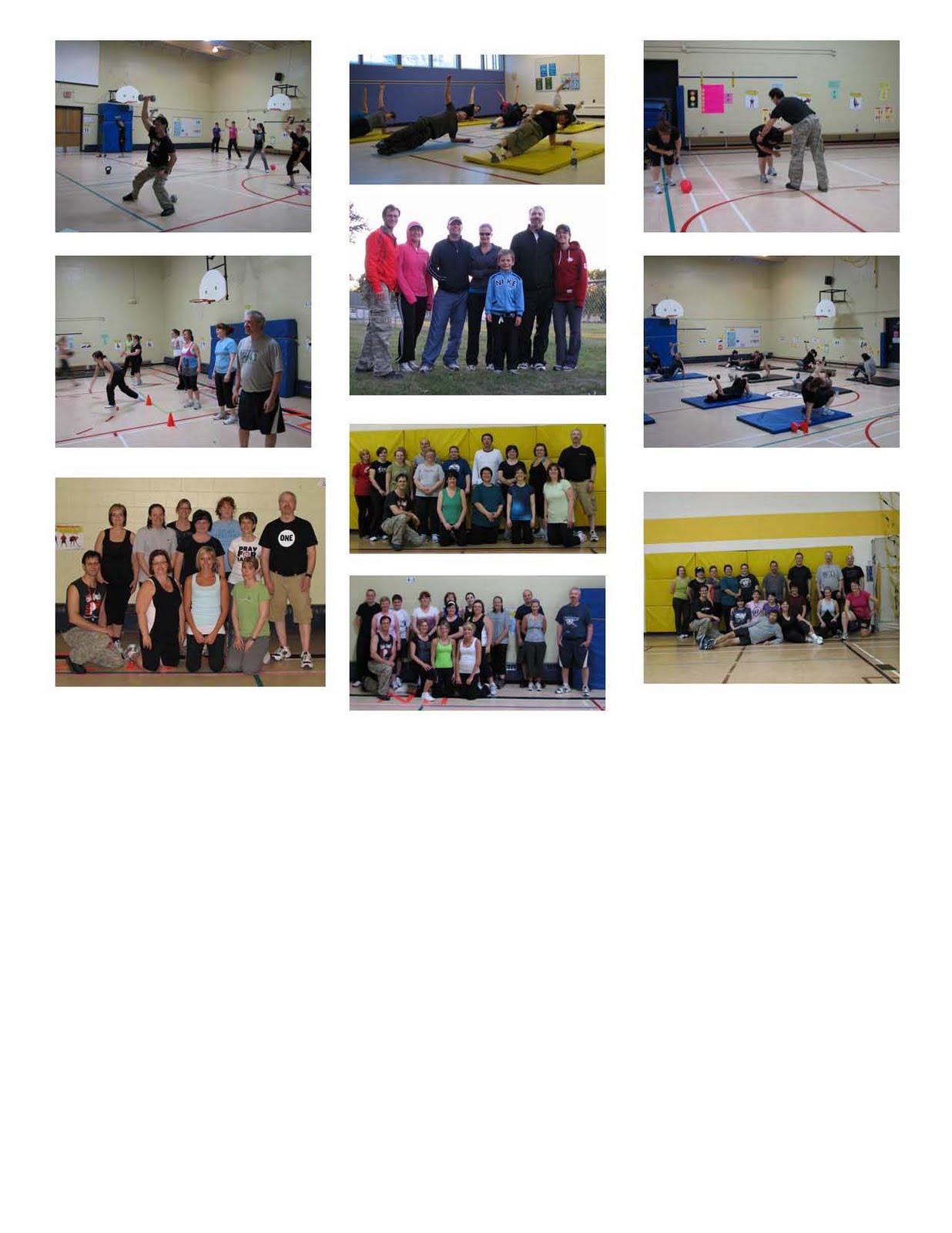
Saturday, December 3, 2011
DYNABODY FITNESS HOLIDAY CHALLENGE
With the Holiday season coming up quick, exercise is the first thing to go when people are busy. People overindulge at holiday parties and have added pounds to deal with. Did you know that obesity is now considered more dangerous than smoking?
To keep you committed to exercise during the Holiday season I’m putting on a Fitness Holiday Challenge to all my current and former fitness bootcamp participants.
The Fitness Holiday Challenge will work on a point system. You accumulate points based on the time spent exercising.up to 30 min. of Exercise - 1 point
up to 60 min. of Exercise - 2 points
over 60 min. of Exercise - 3 points
A Maximum of 3 points per day.
EXERCISES THAT COUNT:
Cardio/Aerobic - Running, Step, Skipping, Calisthenics, etc.
Resistance or Training - Weight Lifting, Bodyweight Exercises, Bands, Tubing, etc.
Active Sport - Hockey, Soccer, Racquet sports, Basketball, Volleyball, etc.
Fun/Moderate Activities - Curling, Bowling, Walking, Yoga, etc. * 1 point only.
For my part, I will include a bodyweight exercise program you can do for the 5 weeks that the bootcamp is off. (We don’t start again until January 17th and 19th)
FREE WORKOUT!
As an added incentive, I will be offering a “workout with Doug session” for one lucky individual – one in December and another in January for all of those who participate in the Challenge. We will hit the gym and go through the paces with a full blown workout session – at no cost to you! (Except for spent calories)
This is a great way to stay motivated and be accountable during the Holiday season!ps: Even if you don't want to participate and would like to try my Bodyweight Exercise program, send me a quick email at dynabody@gmail.com and I will forward the program for you to try.
Sunday, November 6, 2011
You Can NOT outwork a poor diet.
Last month I mentioned that it is estimated that by 2015 75% of Canada’s population will be overweight or obese. Modern society is obsessed with convenience. We are putting personal entertainment and modern technology at a higher priority than our own health. Simply put, we are Lazy!
-Did you know that obese people sit for 2.5 more hours per day than thin people.
-Did you know that over the past 20 years exercise rates stayed about the same while sitting increased by over 8% and obesity doubled?
All is NOT doom and gloom. Especially if you are in the “majority”. Finding a balance between work, school, family and social life may seem impossible. The question here is how devoted are you to your health and vibrancy? If you keep doing what you have always been doing you’re going to have the energy and body you’ve always had. Your body will adapt to whatever you give it – so it’s time to wake up.
A common misunderstanding is that people who are overweight should stick to cardio workouts so that they can “lose weight” before building muscle. Lifting weights is non-impact. The increased muscle gains will better shape your body than cardio.
Remember that intensity rules no matter what type of exercising you are doing. You need to be sweating and breathing hard to really get results. Too many times I’ve seen people at the gym going through the motions – wasting their time and only fooling themselves. Then wonder why they see no results and quit after a short time period.
And here’s a wake up call - The majority of people that work out are focusing on the wrong thing - not only are they doing things inefficiently but they make no effort to improve their diets.
Simply put - YOU CAN NOT OUTWORK A POOR DIET.
A healthy lifestyle requires both exercise and controlled calorie intake (of the healthy variety).
Here are some pointers;
Keep your heart rate up for the duration of your workout. Use the perceived exertion test 0 if you can talk normally while exercising you aren't working hard enough.
Do weights before cardio to burn more fat. By weight training first you burn off your stored glycogen (carbs) first. After this preferred fuel source is used up, your body has no choice but to dip into fat stores once these carbs are used up.
Add some non-exercise specific activity into your day — like taking the stairs
Stop smoking. The reason many people gain weight after quitting smoking is because they stop "going out" for that smoke, and, start to eat more to curb the craving. And if you do quit - DO NOT "try it"for any reason - you will start again! Continue to go outside for a walk. You will also realize your food will taste better.
Now, regarding food....
Flush your system by drinking water with every meal and avoid caffeine and sugar. Yes, coffee withdrawal will bring on a headache but after a few days the symptoms disappear. Try a herbal or green tea or a hot lemon water instead.
Eat breakfast every day. And that doesn’t mean sugary cereal or bagels either. Have an egg and some oatmeal. Sprinkle cinnamon on your oatmeal – the thermogenic properties help you burn fat.
Eat an apple before your meal. This will help curb your appetite.
Eat whole grain foods (bread and pasta) that include the bran, germ and grain seed (endosperm). Note that 100% whole wheat bread is NOT the same since it made with whole wheat flour which is processed and only consists of a portion of grain’s main nutrients.
Ensure you eat protein with every meal. This helps cut the amount of insulin released in half, which actually helps reduce fat storage.
By combining clean eating with resistance training your body will actually be warmer. It’s not the fat that keeps you warm it’s your metabolism. One pound of muscle burns 50 calories per day while one pound of fat only burns 3 calories. Since lean muscle burns more fuel than fat you need to weight train. Now isn’t that a good thing to know when winter is coming??
Finally, you need to stop worrying about weight and focus more on feeling better about yourself and your body. Just remember, the fat will come off in time. Obsessing about it will result in frustration and lack of motivation. It’s one of the main reasons why most people give up. The weight won’t come off any quicker.
Besides, don’t you feel much better after a good workout?
There are no magic formulas for improving your health. Best results come from a long-term strategy involving eating and activity habits. Take baby steps - you have the rest of your life to run...
Wednesday, August 3, 2011
First Aid & CPR Training
EMERGENCY FIRST AID – CPR
Medical emergencies don't occur every day. But when they do, being well informed can help you deal with these situations. Everyone should learn at least the basic first aid and CPR Cardiopulmonary resuscitation) techniques. You may need to use them at any time at home, at school or work or even while you're traveling. Knowing what to do can make the difference to a person's recovery, and you could even save their life.
The goal in learning first aid is to give care to someone suffering from an injury or medical emergency until trained medical help can arrive.
There are four basic steps to take in an emergency:
· Recognize that an emergency has occurred.
· Decide to act
· Call EMS (Emergency Medical Services)
· Give first aid until help arrives
When calling EMS personnel for help, inform the dispatcher; 1) what has happened 2) the address and 3) the phone number from where you are calling.
A Primary Survey
In any emergency , you must first perform a primary survey to determine if any conditions threaten a casualty’s life. Things to consider;
· is the casualty conscious?
· Are there signs of major bleeding / circulation problems?
· Is the casualty breathing?
· Is the person in shock?
CARDIOVASCULAR EMERGENCIES
Sudden Cardiac Arrest (SDA) occurs when the heart unexpectedly stops beating effectively. SCA is a major cause of death in Canada. In sudden cardiac arrest, the heart no longer pumps blood to the brain. Without the oxygen and nutrients supplied by the blood, brain cells begin to die within minutes, and death soon follows.
What are the odds?
The more people in a given workplace, at a public event, etc, the more likely the occurrence of sudden cardiac arrest.
It is estimated there is one cardiac arrest for every 100,000 life-years.
Life years = # of people per location by the average age.
Example 1: Over 2,000 employees with an average age of 40 years = 80,000 life years.
You can expect at least one incident of sudden cardiac arrest in the workplace per year.
Example 2: At a outside event with 5,000 spectators with an average age of 40 years, it works out to two likely incidents of SCA per year. (ie; (5,000 x 40) /100,000)
Those who are at a high risk of having a Cardiac Arrest include; 1) The elderly
2) People who have high levels of stress
3) People who smoke
4) Lack of physical exercise
5) Poor eating habits.
As you can see, only the first factor is out of everyone’s control. However, aging can be slowed down dramatically with changes to eating habits and introducing physical exercise.
Signs and Symptoms of a Heart Attack
* Persistent Chest Pain
* Difficulty breathing
* Neck, abdominal or back pain (women)
* Pale or bluish skin
* Pulse too fast, too slow, or irregular
* Sweating (stress)Nausea and vomiting
Cardiopulmonary resuscitation (CPR)
CPR can help maintain oxygenation and blood circulation. Without CPR, brain cells begin to die within 4 to 6 minutes. CPR provides a minimum of the normal blood flow to the brain and heart. The chance of survival is very slim (around 2%) unless defibrillation (AED) can be applied within 5 minutes.
Using a Automated External Defibrillator (AED) can increase the chance of survival from sudden cardiac arrest by 30 to 74% or more. The AED is a small, easy-to-use device that detects electrical activity of a person’s heart and checks the heart’s rhythm.
The window of opportunity for using an AED is small – defibrillation is best performed within 5 minutes of cardiac arrest. Chances of survival decreases 7-10 percent with every minute that passes after the arrest.
CPR GUIDELINES
QUESTIONS???
Can I kill someone if I do CPR incorrectly?
No. The person in cardiac arrest is already clinically dead. CPR can only help.
What if I crack a rib when I do CPR?
Frequently ribs are broken with the pressure CPR places on the sternum. Up to 30% of cardiac arrest victims have broken ribs as a result of CPR. This happens more frequently with older casualties. But remember, it's better to have a cracked rib than be dead.
Will CPR always save a life?
No, in fact, most instances of CPR for cardiac arrest are unsuccessful (2% success rate , 70% with AED)
When should I stop CPR?
When help arrives to take over, or the victim starts to move.
STROKE
A stroke or CVA (cerebrovascular accident) is caused by a blood clot or bleeding from a ruptured artery in the brain. The risk factors for stroke are similar to those of heart disease.
Signs and symptoms of Stroke Sudden weakness or numbness of the face, arm, leg – usually on one side of the body.
Difficulty talking or understanding speech
Dizziness or confusion
Unconscious
Loss of bladder control
Steps to take in case of a Stroke
· Call EMS (911)
Before the ambulance arrives Here are things you can do next;
· Give CPR or mouth to mouth resuscitation if needed.
· Do not attempt to move them. Make the stroke victim as comfortable as possible. Loosen clothing.
· Do not give them anything to eat or drink. Stroke causes the inability to swallow and they could choke. · Do not take aspirin, because you do not know what kind of stroke it is. Though aspirin can reduce blood clot, it could make hemorrhage worse. If an aspirin has been taken that day, be sure to tell the ER. · Breathe Deeply. Taking slow, deep breaths can help to calm the stroke victim, while providing more oxygen to the brain. Keep them lying down and talk to them reassuringly.
· Keep the Head Cool, the body warm. If you have ice packs, you can apply them to the head briefly keep it cool. Wrap in a thin cloth or it will be too cold. Keeping the head cool cuts down on the inflammatory reaction during stroke and may help with the painful headache during stroke. Covering them with a coat or blanket to keep the body warm will prevent shock.
BLEEDING
Severe bleeding is a life-threatening emergency. Direct Pressure should be applied to decrease the bleeding. If you suspect internal bleeding there is little that a first aider can do - call EMS immediately. Do not dismiss a closed wound as “just a bruise”. If a person complains of severe pain or has trouble moving a body part seek medical attention immediately. Severe internal bleeding may cause the casualty to go into shock.
FIRST AID MYTHS
1) Sucking a Snake Bite Slicing into a newly bitten victim and removing the poison by sucking it out does NOT work. The venom doesn’t just sit in the wound waiting for you to remove it. Cutting into the wound will just create infections. Sucking it out with your mouth is even worse - the snake will just get a two-for-one special that way. Call EMS (911) first. Keep the bite below heart level. Wash the area with warm water and soap. Remove constricting clothing and wrap with an elastic pressure bandage.
2) Butter on Burns Butter and oil are great for basting, but unless you want to make a burn worse, leave them in the kitchen. Oils hold in the heat, exactly the opposite of what a burn victim needs. Cool the burned area with water unless a large part of the body is affected. Cover with moist sterile dressing to prevent infection.
3) Putting Something in a Seizure Patient's Mouth to Bite While somebody suffering a seizure may very well bite his or her tongue, it rarely becomes an airway emergency. Seizures look scary, but generally do very little harm. You're more apt to cause an airway blockage by stuffing an object in the seizure victim's mouth.
4) Breathing Into a Paper Bag for Hyperventilation There are a lot of reasons why we hyperventilate (breath fast). In no case is a paper bag indicated as proper treatment. This one is actually very dangerous. DO NOT USE A PAPER BAG FOR HYPERVENTILATION! Instead, tell the casualty to relax and breathe slowly. Reassurance is often enough to correct hyperventilation.
5) Leaning Back with a Nosebleed I know, I know, mom's going to be mad when you bleed on your soccer uniform, but leaning back will cause you to swallow blood. To control a nosebleed, lean forward and pinch the nostrils together until the bleeding stops.
CONCLUSION
I have only touched on some of the major First Aid and CPR Guidelines. In an emergency situation many people will either panic or freeze. By taking a first aid and CPR training course on a regular basis you can retain what you have learned. You can rest assured that you can help a friend, colleague or loved one in the case of an emergency situation.
References/Links:
http://www.redcross.org
http://www.sja.ca
http://www.strokefamily.org/strokeemergency.html
Medical emergencies don't occur every day. But when they do, being well informed can help you deal with these situations. Everyone should learn at least the basic first aid and CPR Cardiopulmonary resuscitation) techniques. You may need to use them at any time at home, at school or work or even while you're traveling. Knowing what to do can make the difference to a person's recovery, and you could even save their life.
The goal in learning first aid is to give care to someone suffering from an injury or medical emergency until trained medical help can arrive.
There are four basic steps to take in an emergency:
· Recognize that an emergency has occurred.
· Decide to act
· Call EMS (Emergency Medical Services)
· Give first aid until help arrives
When calling EMS personnel for help, inform the dispatcher; 1) what has happened 2) the address and 3) the phone number from where you are calling.
A Primary Survey
In any emergency , you must first perform a primary survey to determine if any conditions threaten a casualty’s life. Things to consider;
· is the casualty conscious?
· Are there signs of major bleeding / circulation problems?
· Is the casualty breathing?
· Is the person in shock?
CARDIOVASCULAR EMERGENCIES
Sudden Cardiac Arrest (SDA) occurs when the heart unexpectedly stops beating effectively. SCA is a major cause of death in Canada. In sudden cardiac arrest, the heart no longer pumps blood to the brain. Without the oxygen and nutrients supplied by the blood, brain cells begin to die within minutes, and death soon follows.
What are the odds?
The more people in a given workplace, at a public event, etc, the more likely the occurrence of sudden cardiac arrest.
It is estimated there is one cardiac arrest for every 100,000 life-years.
Life years = # of people per location by the average age.
Example 1: Over 2,000 employees with an average age of 40 years = 80,000 life years.
You can expect at least one incident of sudden cardiac arrest in the workplace per year.
Example 2: At a outside event with 5,000 spectators with an average age of 40 years, it works out to two likely incidents of SCA per year. (ie; (5,000 x 40) /100,000)
Those who are at a high risk of having a Cardiac Arrest include; 1) The elderly
2) People who have high levels of stress
3) People who smoke
4) Lack of physical exercise
5) Poor eating habits.
As you can see, only the first factor is out of everyone’s control. However, aging can be slowed down dramatically with changes to eating habits and introducing physical exercise.
Signs and Symptoms of a Heart Attack
* Persistent Chest Pain
* Difficulty breathing
* Neck, abdominal or back pain (women)
* Pale or bluish skin
* Pulse too fast, too slow, or irregular
* Sweating (stress)Nausea and vomiting
Cardiopulmonary resuscitation (CPR)
CPR can help maintain oxygenation and blood circulation. Without CPR, brain cells begin to die within 4 to 6 minutes. CPR provides a minimum of the normal blood flow to the brain and heart. The chance of survival is very slim (around 2%) unless defibrillation (AED) can be applied within 5 minutes.
Using a Automated External Defibrillator (AED) can increase the chance of survival from sudden cardiac arrest by 30 to 74% or more. The AED is a small, easy-to-use device that detects electrical activity of a person’s heart and checks the heart’s rhythm.
The window of opportunity for using an AED is small – defibrillation is best performed within 5 minutes of cardiac arrest. Chances of survival decreases 7-10 percent with every minute that passes after the arrest.
CPR GUIDELINES
For Adults: Chest Compressions are Continuous
Try to compress at 100 beats per minute and about two inches (five centimeters) deep until emergency help arrives.
For Children, Infants, Drownings and cases where cardiac arrest hasn't been witnessed, you must do both Chest Compressions and Ventilation.
Ventilation (Rescue Breaths)
Normal breath given over 1 second until chest rises
Chest Compression to Ventilation Ratio: 30:2
Chest Compression Landmarking:
Center of the chest (heel of hand between the nipples) for an Adult or child
Below the nipple line at chest center for an infant
AED - 1 shock then 5 cycles (2 minutes) of CPR.
For Children, Infants, Drownings and cases where cardiac arrest hasn't been witnessed, you must do both Chest Compressions and Ventilation.
Ventilation (Rescue Breaths)
Normal breath given over 1 second until chest rises
Chest Compression to Ventilation Ratio: 30:2
Chest Compression Landmarking:
Center of the chest (heel of hand between the nipples) for an Adult or child
Below the nipple line at chest center for an infant
AED - 1 shock then 5 cycles (2 minutes) of CPR.
Can I kill someone if I do CPR incorrectly?
No. The person in cardiac arrest is already clinically dead. CPR can only help.
What if I crack a rib when I do CPR?
Frequently ribs are broken with the pressure CPR places on the sternum. Up to 30% of cardiac arrest victims have broken ribs as a result of CPR. This happens more frequently with older casualties. But remember, it's better to have a cracked rib than be dead.
Will CPR always save a life?
No, in fact, most instances of CPR for cardiac arrest are unsuccessful (2% success rate , 70% with AED)
When should I stop CPR?
When help arrives to take over, or the victim starts to move.
STROKE
A stroke or CVA (cerebrovascular accident) is caused by a blood clot or bleeding from a ruptured artery in the brain. The risk factors for stroke are similar to those of heart disease.
Signs and symptoms of Stroke Sudden weakness or numbness of the face, arm, leg – usually on one side of the body.
Difficulty talking or understanding speech
Dizziness or confusion
Unconscious
Loss of bladder control
Steps to take in case of a Stroke
· Call EMS (911)
Before the ambulance arrives Here are things you can do next;
· Give CPR or mouth to mouth resuscitation if needed.
· Do not attempt to move them. Make the stroke victim as comfortable as possible. Loosen clothing.
· Do not give them anything to eat or drink. Stroke causes the inability to swallow and they could choke. · Do not take aspirin, because you do not know what kind of stroke it is. Though aspirin can reduce blood clot, it could make hemorrhage worse. If an aspirin has been taken that day, be sure to tell the ER. · Breathe Deeply. Taking slow, deep breaths can help to calm the stroke victim, while providing more oxygen to the brain. Keep them lying down and talk to them reassuringly.
· Keep the Head Cool, the body warm. If you have ice packs, you can apply them to the head briefly keep it cool. Wrap in a thin cloth or it will be too cold. Keeping the head cool cuts down on the inflammatory reaction during stroke and may help with the painful headache during stroke. Covering them with a coat or blanket to keep the body warm will prevent shock.
BLEEDING
Severe bleeding is a life-threatening emergency. Direct Pressure should be applied to decrease the bleeding. If you suspect internal bleeding there is little that a first aider can do - call EMS immediately. Do not dismiss a closed wound as “just a bruise”. If a person complains of severe pain or has trouble moving a body part seek medical attention immediately. Severe internal bleeding may cause the casualty to go into shock.
FIRST AID MYTHS
1) Sucking a Snake Bite Slicing into a newly bitten victim and removing the poison by sucking it out does NOT work. The venom doesn’t just sit in the wound waiting for you to remove it. Cutting into the wound will just create infections. Sucking it out with your mouth is even worse - the snake will just get a two-for-one special that way. Call EMS (911) first. Keep the bite below heart level. Wash the area with warm water and soap. Remove constricting clothing and wrap with an elastic pressure bandage.
2) Butter on Burns Butter and oil are great for basting, but unless you want to make a burn worse, leave them in the kitchen. Oils hold in the heat, exactly the opposite of what a burn victim needs. Cool the burned area with water unless a large part of the body is affected. Cover with moist sterile dressing to prevent infection.
3) Putting Something in a Seizure Patient's Mouth to Bite While somebody suffering a seizure may very well bite his or her tongue, it rarely becomes an airway emergency. Seizures look scary, but generally do very little harm. You're more apt to cause an airway blockage by stuffing an object in the seizure victim's mouth.
4) Breathing Into a Paper Bag for Hyperventilation There are a lot of reasons why we hyperventilate (breath fast). In no case is a paper bag indicated as proper treatment. This one is actually very dangerous. DO NOT USE A PAPER BAG FOR HYPERVENTILATION! Instead, tell the casualty to relax and breathe slowly. Reassurance is often enough to correct hyperventilation.
5) Leaning Back with a Nosebleed I know, I know, mom's going to be mad when you bleed on your soccer uniform, but leaning back will cause you to swallow blood. To control a nosebleed, lean forward and pinch the nostrils together until the bleeding stops.
CONCLUSION
I have only touched on some of the major First Aid and CPR Guidelines. In an emergency situation many people will either panic or freeze. By taking a first aid and CPR training course on a regular basis you can retain what you have learned. You can rest assured that you can help a friend, colleague or loved one in the case of an emergency situation.
References/Links:
http://www.redcross.org
http://www.sja.ca
http://www.strokefamily.org/strokeemergency.html
Subscribe to:
Posts (Atom)