Showing posts with label corporate employee wellness. Show all posts

Tuesday, August 28, 2012

FALL BOOTCAMP SESSIONS START OCTOBER 9Th & 11th :

Mark it on your calendar!!!

The indoor bootcamps through St. James Con. Ed. Start in just over a month.

Sessions run from 6:30 to 8:00 pm and cost is $79 each

Register online at:

Dynabody Fitness Bootcamp - Tuesday - Bannatyne School

Dynabody Fitness Bootcamp - Thursday - Strathmillan School

or call: 832-9637 to Register by phone


Dynabody TOTAL FITNESS Bootcamp is a complete workout program!  
 It is a fun and exciting workout for all fitness levels, sizes, and ages (16+).  Each class will help improve your anaerobic/aerobic conditioning, coordination and timing.  Have you ever tried kettlebells? an exercise ball?  What about a bosu balance trainer?   This Bootcamp has many innovative activities that incorporate calisthenics, obstacle courses, functional circuit training, abdominal and core body exercises along with games,  martial arts, and yoga to boot.  And the best thing is – it’s fun!


Keep on exercising – your body needs it. And remember – USE IT OR LOSE IT!

Monday, June 18, 2012

DYNABODY FITNESS BOOTCAMPS

The summer Fitness Bootcamps are up still on until the end of September.

Tuesday and Thursday Evenings  - Start time is 6:00 pm.

Location: 

Hot & Sunny:  Strathmillan Lodge Playground  (under the Oak trees).

Wet / Damp:  Strathmillan School Playground parking lot

Phone or text:  204-771-0061  for more information.

Saturday, May 5, 2012

ONE WORD TO REMEMBER THAT WILL BRING SUCCESS

I just read an article that stated that over-training ages the body. This is something that I do agree on.  Your body must recover in order to improve.

However, this only has a little to do with what I’d like to talk about today.  Now, there is just one word that will bring success to anything you do.  Take a guess….

Well…

It’s AWARENESS.

You need to be Aware of what you are doing.

If you are over-training you should be aware.  Your body will tell you.  You will seem more tired, can’t perform as well as you have in the past, etc.  Many people that over train are addicted and feel guilty if they miss out on a workout.  Even highly trained athletes need time to recover.

Does your workouts bring progressive results?  Are you just doing the same thing that you’ve always been doing?  You must be AWARE of your progress, your goals.  Hey, if you are happy with your body and current fitness level then all you need to do is maintain it.  If not you have to realize that more action is required.

When you exercise do you focus on what you are doing?  Or do you just go through the motions.  If you are too busy talking during your workout you aren’t exercising hard enough.  Save the chatter until after class, or at least bring it to a minimum between sets.

Here is some other life examples relating to Awareness;

Driving.  Sure speed kills but it’s not the real culprit in most accidents.  I do have a beef about the government’s campaign against speed.  The main factor here is lack of awareness.  Be aware of your surroundings, the conditions and the idiot in front of you. Stay off your cell phone.  You can’t see what’s in front of you if you have your head down while you’re texting. You should be able to react in time when that car barrels through the stop sign at the intersection ahead.

How many people have you seen cross the street without looking?  Pedestrian vs Auto – the latter wins all the time.

I help teach self-defense.  Awareness is a key factor in keeping yourself Alive and out of trouble.  A predator looks for an easy target.  They rely on the element of surprise.  Many people look at the ground while walking.  Even more are too busy looking at their smartphones than noticing what’s around them.

Are you engaged in your work?  School work?  Being aware of what you have to do and planning for the task(s) in hand results in success.  Successful people have goals and are aware of what they need to do to get there. 

CONCLUSION

To get results you must be AWARE.  Know where you are and what you need to do to accomplish your goals.  Visualize what you are trying to achieve. 

Studies have shown that without the proper nutrients and exercise, your body will age about 6 months EXTRA for every year that passes!   If you are 50 you will look and feel like your 55!  So much for the 50 is the new 40….. Your body is not a clock.  People are  tired and overweight not because they are old it’s because they eat, think and move like an old person.  As I explained last time - Everything in the universe either grows or dies.  You must continue to grow - and NOT in fat....  Stay focused  -  it’s your mental attitude and a healthy lifestyle that will get you there.

You really must be AWARE!

Thursday, January 12, 2012

Survive the holiday?

Happy New Year everyone! Are you glad it’s over? So did you over do it again this year? Most people do. Now that the overindulgence is done it’s time for a rude awakening.

Did you know that December and January are the deadliest months for heart disease? This is a result of a combination of rich high fat meals, alcohol and stress.

Sugary sodas, fruit drinks and alcohol all contribute to the problem. Based on research from the University of North Carolina, daily intake of calories from beverages has increased by 94 percent to an additional 222 calories per day. That could result in 26 extra pounds in one year!

As we know, losing weight and getting in shape has always been at the forefront of New Years resolutions. If you were one of the majority that gained weight during the holidays, well it’s time to take action.

But before you spend your valuable time, energy and money there is a few things you should consider;

First, you must decide that YOUR HEALTH AND YOUR BODY ARE THE HIGHEST PRIORITIES IN YOUR LIFE. If you don’t have your health, how can you enjoy life? Even if you have kids, how can you look after them or participate in activities with them if you ignore your health? Lead by example.

Second, is WILLPOWER - you must WANT to get in shape and must realize that IT WILL TAKE EFFORT.

Losing fat is not easy. Your body wants to stay the way it is and requires hard work and willpower to succeed in a person’s quest to become leaner. There are no magic pills or fads that are effective in the long run. Models and Movie stars that endorse products are there to make money.

Now this is very important – PICK YOUR FITNESS ROUTINE WISELY.

If you are overweight DO NOT make a commitment to take up running. This is a recipe for disaster. The risk of ankle, knee and hip injuries are too great for those wanting to drop weight.

To put things in perspective, running is considered a plyometric exercise – just like hopping on one leg (then the other). Running just one mile can amount to around 1760 “hops” for the average person. Running and plyometrics are advanced exercises that should only be done after you’ve built up a base of strength to handle the weight of your body.

And look at who is running the class or assisting in your workouts. If the instructor is out of shape, this may not be for you.

INCORPORATE ALL COMPONENTS OF  PHYSICAL FITNESS in your workout routine – Aerobic, Muscular, Flexibility.

a) Aerobic Exercise– rather than running try the elliptical or cross trainer for cardio. How about cross country skiing, rollerblading, dancing, zumba, you name it. One of the best and inexpensive cardio workouts is a skipping rope. Just remember to get your heart rate up.

b)Resistance Training – this is more important to weight loss than cardio. Weight training is easy on your joints and if done correctly will get your heart rate elevated.

c) Flexibility – Stretching is an important but overlooked component of fitness. To enhance your range of motion, release stress, reduce soreness and improve your blood flow doing stretches is a must. Try yoga – this won’t increase your strength but will improve your body’s mobility. It’s great as a cooldown.

Every time I go to the gym I shake my head at what some people are doing. Invest in a workout orientation by someone who knows what they are doing. It’s important to understand how to do an exercise properly. This will save your body and you will get the most out of your workout. It’s a small price to pay with huge rewards.

And please, warm-up. You need to get the blood flowing into the muscles before you start stressing the body. Most injuries occur within the first six minutes of doing an activity so reduce this risk!

INTENSITY RULES – If you aren’t huffing and puffing after a set, or sweating after a workout then you aren’t working hard enough. If you can chat with the person next to you, then you’re not working hard enough. Stay focused and stop wasting your valuable time. This is one of the main reasons why people don’t get results and give up exercising. 50% do so within the first 3 months! Save the conversations after your workout when you are cooling down.

MAKE A PLAN – SET UP YOUR GOALS – what you want to achieve, the times you have available. Write it down.

Only 5 –10% ever write anything down during the process.

Those who succeed? The same number that write things down – 10%.

EAT SMALLER MEALS MORE OFTEN AND CHOOSE YOUR FOODS WISELY

Breakfast is your most important meal to start off the day.  Aim for Five or six SMALL meals or healthy snacks. Include protein with every meal. Stop eating after 7pm. Get rid of the junk foods and have fruits and vegetables handy.  This doesn’t mean not to treat yourself – just remember, it's a TREAT - something to enjoy and cherish ant not eat daily.

GET ADEQUATE SLEEP – this will help build up your immune system. You body gets stronger when you rest.

Make exercise a habit. Take baby steps but PROGRESS is the key. Periodize your routines. Change things up to keep your body guessing. Trying new things challenges you to move forward. This is why I like to change up my fitness bootcamp exercises and my own workouts regularly.

Most importantly - Have fun with it!

Sunday, November 6, 2011

You Can NOT outwork a poor diet.

Last month I mentioned that it is estimated that by 2015 75% of Canada’s population will be overweight or obese. Modern society is obsessed with convenience. We are putting personal entertainment and modern technology at a higher priority than our own health. Simply put, we are Lazy!

-Did you know that obese people sit for 2.5 more hours per day than thin people.

-Did you know that over the past 20 years exercise rates stayed about the same while sitting increased by over 8% and obesity doubled?

All is NOT doom and gloom. Especially if you are in the “majority”. Finding a balance between work, school, family and social life may seem impossible. The question here is how devoted are you to your health and vibrancy? If you keep doing what you have always been doing you’re going to have the energy and body you’ve always had. Your body will adapt to whatever you give it – so it’s time to wake up.

A common misunderstanding is that people who are overweight should stick to cardio workouts so that they can “lose weight” before building muscle. Lifting weights is non-impact. The increased muscle gains will better shape your body than cardio.

Remember that intensity rules no matter what type of exercising you are doing. You need to be sweating and breathing hard to really get results. Too many times I’ve seen people at the gym going through the motions – wasting their time and only fooling themselves. Then wonder why they see no results and quit after a short time period.

And here’s a wake up call - The majority of people that work out are focusing on the wrong thing - not only are they doing things inefficiently but they make no effort to improve their diets.

Simply put - YOU CAN NOT OUTWORK A POOR DIET.

A healthy lifestyle requires both exercise and controlled calorie intake (of the healthy variety).

Here are some pointers;

Keep your heart rate up for the duration of your workout. Use the perceived exertion test 0 if you can talk normally while exercising you aren't working hard enough.

Do weights before cardio to burn more fat. By weight training first you burn off your stored glycogen (carbs) first. After this preferred fuel source is used up, your body has no choice but to dip into fat stores once these carbs are used up.

Add some non-exercise specific activity into your day — like taking the stairs

Stop smoking. The reason many people gain weight after quitting smoking is because they stop "going out" for that smoke, and, start to eat more to curb the craving. And if you do quit - DO NOT "try it"for any reason - you will start again! Continue to go outside for a walk. You will also realize your food will taste better.

Now, regarding food....

Flush your system by drinking water with every meal and avoid caffeine and sugar. Yes, coffee withdrawal will bring on a headache but after a few days the symptoms disappear. Try a herbal or green tea or a hot lemon water instead.

Eat breakfast every day. And that doesn’t mean sugary cereal or bagels either. Have an egg and some oatmeal. Sprinkle cinnamon on your oatmeal – the thermogenic properties help you burn fat.

Eat an apple before your meal. This will help curb your appetite.

Eat whole grain foods (bread and pasta) that include the bran, germ and grain seed (endosperm). Note that 100% whole wheat bread is NOT the same since it made with whole wheat flour which is processed and only consists of a portion of grain’s main nutrients.

Ensure you eat protein with every meal. This helps cut the amount of insulin released in half, which actually helps reduce fat storage.

By combining clean eating with resistance training your body will actually be warmer. It’s not the fat that keeps you warm it’s your metabolism. One pound of muscle burns 50 calories per day while one pound of fat only burns 3 calories. Since lean muscle burns more fuel than fat you need to weight train. Now isn’t that a good thing to know when winter is coming??

Finally, you need to stop worrying about weight and focus more on feeling better about yourself and your body. Just remember, the fat will come off in time. Obsessing about it will result in frustration and lack of motivation. It’s one of the main reasons why most people give up. The weight won’t come off any quicker.

Besides, don’t you feel much better after a good workout?

There are no magic formulas for improving your health. Best results come from a long-term strategy involving eating and activity habits. Take baby steps - you have the rest of your life to run...

Wednesday, August 3, 2011

First Aid & CPR Training

EMERGENCY FIRST AID – CPR

Medical emergencies don't occur every day. But when they do, being well informed can help you deal with these situations. Everyone should learn at least the basic first aid and CPR Cardiopulmonary resuscitation) techniques. You may need to use them at any time at home, at school or work or even while you're traveling. Knowing what to do can make the difference to a person's recovery, and you could even save their life.

The goal in learning first aid is to give care to someone suffering from an injury or medical emergency until trained medical help can arrive.

There are four basic steps to take in an emergency:
· Recognize that an emergency has occurred.
· Decide to act
· Call EMS (Emergency Medical Services)
· Give first aid until help arrives

When calling EMS personnel for help, inform the dispatcher; 1) what has happened 2) the address and 3) the phone number from where you are calling.

A Primary Survey
In any emergency , you must first perform a primary survey to determine if any conditions threaten a casualty’s life. Things to consider;
· is the casualty conscious?
· Are there signs of major bleeding / circulation problems?
· Is the casualty breathing?
· Is the person in shock?

CARDIOVASCULAR EMERGENCIES
Sudden Cardiac Arrest (SDA) occurs when the heart unexpectedly stops beating effectively. SCA is a major cause of death in Canada. In sudden cardiac arrest, the heart no longer pumps blood to the brain. Without the oxygen and nutrients supplied by the blood, brain cells begin to die within minutes, and death soon follows.

What are the odds?
The more people in a given workplace, at a public event, etc, the more likely the occurrence of sudden cardiac arrest.

It is estimated there is one cardiac arrest for every 100,000 life-years.

Life years = # of people per location by the average age.

Example 1: Over 2,000 employees with an average age of 40 years = 80,000 life years.
You can expect at least one incident of sudden cardiac arrest in the workplace per year.

Example 2: At a outside event with 5,000 spectators with an average age of 40 years, it works out to two likely incidents of SCA per year. (ie; (5,000 x 40) /100,000)

Those who are at a high risk of having a Cardiac Arrest include; 1) The elderly
2) People who have high levels of stress
3) People who smoke
4) Lack of physical exercise
5) Poor eating habits.

As you can see, only the first factor is out of everyone’s control. However, aging can be slowed down dramatically with changes to eating habits and introducing physical exercise.

Signs and Symptoms of a Heart Attack
* Persistent Chest Pain
* Difficulty breathing
* Neck, abdominal or back pain (women)
* Pale or bluish skin
* Pulse too fast, too slow, or irregular
* Sweating (stress)Nausea and vomiting

Cardiopulmonary resuscitation (CPR)
CPR can help maintain oxygenation and blood circulation. Without CPR, brain cells begin to die within 4 to 6 minutes. CPR provides a minimum of the normal blood flow to the brain and heart. The chance of survival is very slim (around 2%) unless defibrillation (AED) can be applied within 5 minutes.

Using a Automated External Defibrillator (AED) can increase the chance of survival from sudden cardiac arrest by 30 to 74% or more. The AED is a small, easy-to-use device that detects electrical activity of a person’s heart and checks the heart’s rhythm.

The window of opportunity for using an AED is small – defibrillation is best performed within 5 minutes of cardiac arrest. Chances of survival decreases 7-10 percent with every minute that passes after the arrest.

CPR GUIDELINES

For Adults: Chest Compressions are Continuous Try to compress at 100 beats per minute and about two inches (five centimeters) deep until emergency help arrives.

For Children, Infants, Drownings and cases where cardiac arrest hasn't been witnessed, you must do both Chest Compressions and Ventilation.
Ventilation (Rescue Breaths)
Normal breath given over 1 second until chest rises

Chest Compression to Ventilation Ratio:
30:2

Chest Compression Landmarking:
Center of the chest (heel of hand between the nipples) for an Adult or child
Below the nipple line at chest center for an infant

AED - 1 shock then 5 cycles (2 minutes) of CPR.

QUESTIONS???
Can I kill someone if I do CPR incorrectly?
No. The person in cardiac arrest is already clinically dead. CPR can only help.

What if I crack a rib when I do CPR?
Frequently ribs are broken with the pressure CPR places on the sternum. Up to 30% of cardiac arrest victims have broken ribs as a result of CPR. This happens more frequently with older casualties. But remember, it's better to have a cracked rib than be dead.

Will CPR always save a life?
No, in fact, most instances of CPR for cardiac arrest are unsuccessful (2% success rate , 70% with AED)

When should I stop CPR?
When help arrives to take over, or the victim starts to move.

STROKE
A stroke or CVA (cerebrovascular accident) is caused by a blood clot or bleeding from a ruptured artery in the brain. The risk factors for stroke are similar to those of heart disease.

Signs and symptoms of Stroke Sudden weakness or numbness of the face, arm, leg – usually on one side of the body.
Difficulty talking or understanding speech
Dizziness or confusion
Unconscious
Loss of bladder control

Steps to take in case of a Stroke
· Call EMS (911)

Before the ambulance arrives Here are things you can do next;
· Give CPR or mouth to mouth resuscitation if needed.
· Do not attempt to move them. Make the stroke victim as comfortable as possible. Loosen clothing.
· Do not give them anything to eat or drink. Stroke causes the inability to swallow and they could choke. · Do not take aspirin, because you do not know what kind of stroke it is. Though aspirin can reduce blood clot, it could make hemorrhage worse. If an aspirin has been taken that day, be sure to tell the ER. · Breathe Deeply. Taking slow, deep breaths can help to calm the stroke victim, while providing more oxygen to the brain. Keep them lying down and talk to them reassuringly.
· Keep the Head Cool, the body warm. If you have ice packs, you can apply them to the head briefly keep it cool. Wrap in a thin cloth or it will be too cold. Keeping the head cool cuts down on the inflammatory reaction during stroke and may help with the painful headache during stroke. Covering them with a coat or blanket to keep the body warm will prevent shock.

BLEEDING
Severe bleeding is a life-threatening emergency. Direct Pressure should be applied to decrease the bleeding. If you suspect internal bleeding there is little that a first aider can do - call EMS immediately. Do not dismiss a closed wound as “just a bruise”. If a person complains of severe pain or has trouble moving a body part seek medical attention immediately. Severe internal bleeding may cause the casualty to go into shock.

FIRST AID MYTHS
1) Sucking a Snake Bite Slicing into a newly bitten victim and removing the poison by sucking it out does NOT work. The venom doesn’t just sit in the wound waiting for you to remove it. Cutting into the wound will just create infections. Sucking it out with your mouth is even worse - the snake will just get a two-for-one special that way. Call EMS (911) first. Keep the bite below heart level. Wash the area with warm water and soap. Remove constricting clothing and wrap with an elastic pressure bandage.
2) Butter on Burns Butter and oil are great for basting, but unless you want to make a burn worse, leave them in the kitchen. Oils hold in the heat, exactly the opposite of what a burn victim needs. Cool the burned area with water unless a large part of the body is affected. Cover with moist sterile dressing to prevent infection.
3) Putting Something in a Seizure Patient's Mouth to Bite While somebody suffering a seizure may very well bite his or her tongue, it rarely becomes an airway emergency. Seizures look scary, but generally do very little harm. You're more apt to cause an airway blockage by stuffing an object in the seizure victim's mouth.
4) Breathing Into a Paper Bag for Hyperventilation There are a lot of reasons why we hyperventilate (breath fast). In no case is a paper bag indicated as proper treatment. This one is actually very dangerous. DO NOT USE A PAPER BAG FOR HYPERVENTILATION! Instead, tell the casualty to relax and breathe slowly. Reassurance is often enough to correct hyperventilation.
5) Leaning Back with a Nosebleed I know, I know, mom's going to be mad when you bleed on your soccer uniform, but leaning back will cause you to swallow blood. To control a nosebleed, lean forward and pinch the nostrils together until the bleeding stops.

CONCLUSION
I have only touched on some of the major First Aid and CPR Guidelines. In an emergency situation many people will either panic or freeze. By taking a first aid and CPR training course on a regular basis you can retain what you have learned. You can rest assured that you can help a friend, colleague or loved one in the case of an emergency situation.

References/Links:
http://www.redcross.org
http://www.sja.ca
http://www.strokefamily.org/strokeemergency.html

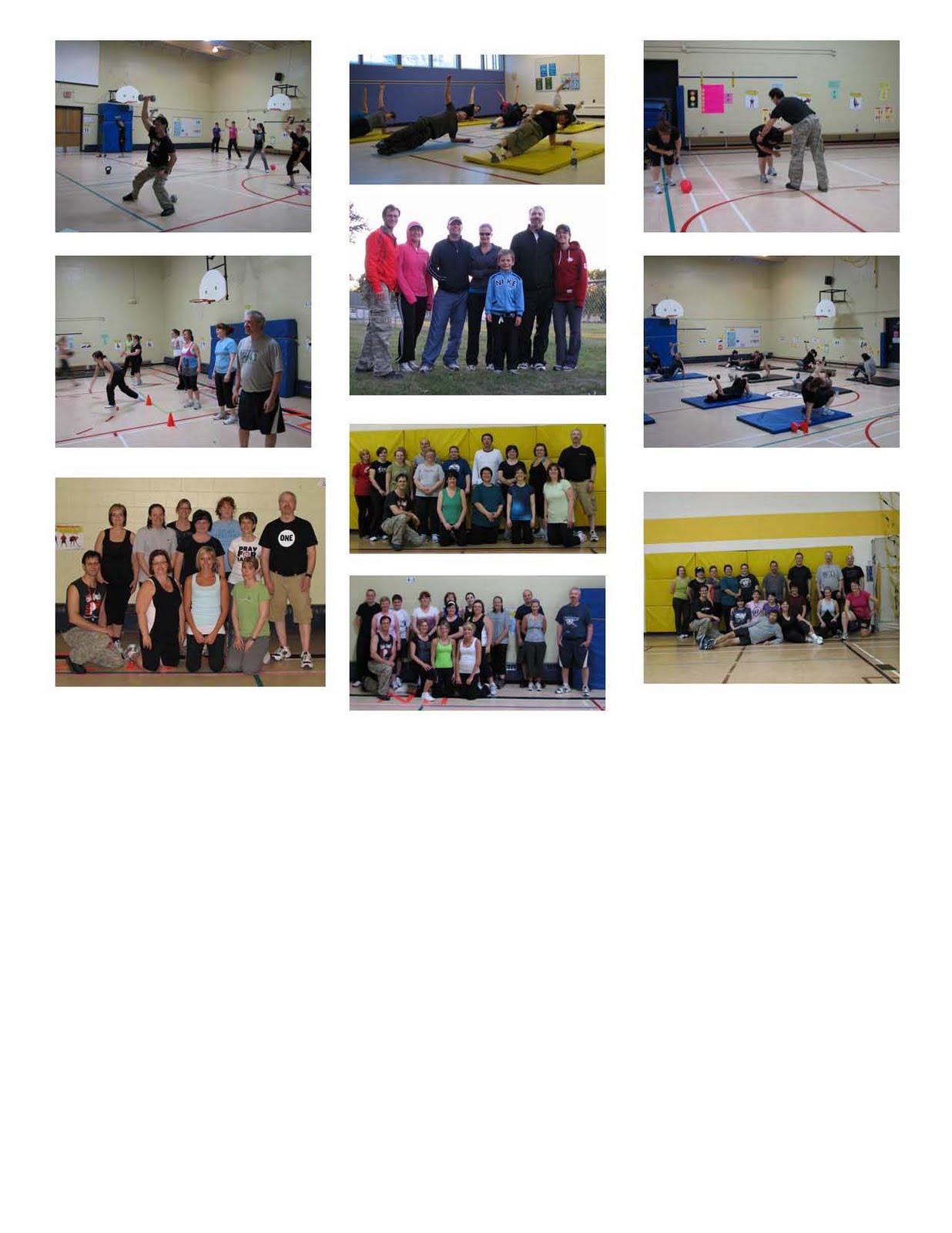
Saturday, June 18, 2011

SUMMER BOOTCAMPS - TUESDAY & THURSDAY

FINAL BOOTCAMP

This week is the final bootcamps of the spring session. I’ve seen some great progress by all of the participants. Great job everyone! Remember – “USE IT OR LOSE IT”

These last two classes are open to all so if you’d like to join in and have fun feel free to come on down!

Tuesday: Bannatyne School Thursday: Strathmillan School 6:30 to 8:00 pm

SUMMER FITNESS BOOT CAMPS – starts the following week!

The Summer Fitness Bootcamp sessions are planned for Tuesdays and Thursdays evenings – starting June 28th and June 30th and runs through to September.

This 1 hour session will be a good challenge for all.

Cost is $75 for 10 Tuesday or 10 Thursday classes. All 20 classes for just $100!

Start time is 6:30pm.

Sunday, July 11, 2010

Stay Hydrated – Water is critical for Body Health


Water is the critical component to overall body health. Failing to keep hydrated will have a negative impact on almost every function of your entire body. Your body is made up of about 75% water. 85 % of our brains are made up of water. Lean muscle tissue is 70% water. 
 Water does not contain a single calorie – yet it is the most important nutrient. Water is necessary for your survival. Water keeps all the cells in your body nourished. Water also conducts electricity – which is the main element to keep your heart pumping. You can survive for a long time without food, but without water you would die in a few days. Water is essential for muscle building. In addition, intense training can put unwanted stress on your joints and connective tissue. 
Water is important to physical performance. A 4% drop in your hydration can lead to a 20% decrease in muscle contractions. Not only will water increase your strength, but it helps to prevent injuries during exercise. Water helps to lubricate the synovial fluid in the joints and forms a protective “cushion” around them. Want some more reasons to drink water? In a University of Washington study, One glass of water shut down midnight hunger pangs for almost 100% of the dieters. A mere 2% drop in body water can trigger fuzzy short-term Memory. Drinking 5 glasses of water daily decreases the risk of colon cancer by 45%, plus it can slash the risk of breast cancer by 79%., and one is 50% less likely to develop bladder cancer. 
  DEHYDRATION 
 Dehydration – occurs when the body’s water level drops below that required for adequate circulation and normal body function. Symptoms of dehydration include: face flushes, you stop sweating, skin turns cold, you become weak, dizzy and tired, your muscles cramp and head hurts. 
 Dehydration is the # 1 reason for day time fatigue. Plus, as you age you tend to dry out. 75% of North Americans are chronically dehydrated. Many of those mistake dehydration for hunger. If dehydrated, your body will selectively take water from areas that are less important for survival – such as your joints, spinal disks and gums. Dehydration thickens the blood, making it concentrated and results in excess strain on the heart. Not drinking enough liquid reduces blood flow to the digestive system – inducing nausea and discomfort. 
 Do you complain about low-back pain? The disks in your lumbar spine uses water volume as hydraulic support for the weight of the upper body. Dehydrated disks flatten and causes the vertebrae to become in-stable and results in low-back pain. It is important that you do not drink too much water. Although rare, Hyponatremia or Water Intoxication happens when you drink excessive amounts of water which dilutes the salt content in your blood. 
  HOW MUCH WATER SHOULD I DRINK 
The human body needs about two litres of water per day. A general rule to calculate the amount of water to drink is to divide your weight by 2 which equals the number of ounces of water to drink per day. While exercising, take three to four sips of water every 10 minutes if possible, or five to six swallows every 15 minutes. 
  TAP WATER VS BOTTLED WATER - SAVE THE ENVIRONMENT 
One pet peave I have is the complaints about tap water and the over abundant waste from bottled water. People are being seduced that bottled water is the key to health and well being. Bottled water is not necessarily cleaner or safer than most tap water in North America. The very high-quality water coming out of our taps is easy on the environment and our pocket books. Canada’s drinking water is strictly regulated for quality. 
 Tap water is disinfected with chlorine to kill bacteria and viruses that can cause serious illness and death. The chlorination of drinking water has virtually eliminated typhoid fever, cholera, and many other waterborne diseases from the western world. Tap water may sometimes look or taste differently, but that doesn’t mean it isn’t safe. I keep a jug of tap water in the fridge and refill water bottles regularly. By keeping the bottle in the refrigerator for at least 8 hours any chlorine taste will dissipate. "20/20" took five bottles of national brands of bottled water and a sample of tap water from a drinking fountain in the middle of New York City and sent them to the University of New Hampshire to test for bacteria, There was no difference between the New York City tap water and the bottled waters evaluated. And in a blind taste test bottled water was not superior than tap water. 
 In The US, tap water is regulated US Environmental Protection Agency, where as bottled water is regulated by the Food & Drug Administration. Tap water must be filtered and /or disinfected whereas no requirements are necessary for bottled water. Tap water is tested by certified labs whereas such testing is not required for bottlers. There are strict reporting requirements of test results for tap water – none for bottlers. Disinfectant is not present in bottled water, whereas chlorine is used in tap water to kill bacteria. 
 Did you know it takes 3 litres of fresh water to produce 1 litre of bottled water? Bottled water is a huge cost in wasted resources. The energy cost of producing a plastic bottles from by-products of crude oil, transporting the water and then disposing of the containers in landfill sites make bottled water one of the most wasteful luxuries. 
  CONCLUSION 
 It doesn’t matter if you prefer bottled water or tap water, during the hot summer months it is even more important to drink enough water. Before drinking your morning cup of coffee, drink a glass of water to help keep you hydrated. 
 If you haven’t been drinking enough water here’s some benefits you may notice: In 24 hours Energy levels increase by 8 % In 72 hours Blue moods left and sleep improves In one week chronic back pain ends In 2 weeks Joint Pain eases In 3 weeks Peptic ulcers heal. *First Magazine Aug.20, 2007. In the light of the increased hype of 'special' water preparations, it is important to take notice that there are definite and proven health benefits from simply drinking more water. Changing your fluid intake from coffee, tea, sport drinks and alcohol to mineral or tap water will help keep your body running at it peak performance through out the day.

Thursday, August 6, 2009

Abs - Got your 6 pack abs yet?

Now that summer is here people are wondering why their quest for a great body – those six pack abs are not anywhere in sight.

It appears that more people have opted for grabbing a 6 pack of beer from the vendor than from trimming down their waistline for those much cherished “Six-Pack”.

No muscle group is more noticeable for men or woman than their abs. In order to have the appearance of a six-pack, you must lower your body fat levels. Doing endless situps and crunches will NOT create a smaller waist or flatter stomach.

Getting “cut” is the development of the bands of connective tissue of the rectus abdominis muscle into deep grooves combined with low levels of subcutaneous fat (fat storage).

Your abdominals are like any other muscle in your body. They can be overworked. Doing endless ab work will not reduce the size of your waistline. On the flip side, it is unlikely that doing too much Ab work, especially with higher intensity/resistance, will result in giving you a big waist. Your ab muscles have a relatively small proportion of fast-twitch muscle fibers and are smaller and less leveraged than other muscle groups.

What is required to get Killer Abs?

First, performing strength training for all of your major muscle groups with moderate to heavy weights. This includes strengthening your midsection with added resistance and honing in on core training. Not only will this tighten your abs, but will help to boost your metabolism making your body a fat burning machine.

Second, the best way to burn fat is by doing high intensity interval cardio/aerobic exercise.

Finally, and most importantly – THINK NUTRITION - you must eat smart. This is a must. You have to lose body fat, not weight, in order to “see” your abs and this can only happen when you eat high quality foods. This will help you control your blood sugar levels, insulin levels, and energy levels. Insulin management will help you lose fat and prevent you from gaining fat.

Some Ab Mistakes to consider:

1.Eating too big of portions – moderation is the key.
2. Spot Reduction does not work – you need to lose fat.
3.Having an unbalanced diet – focus on 5 or 6 balanced meals per day AND EAT BREAKFAST!
4. Lack of concentration – aiming for reps rather than technique.
5. Not drinking enough water – water helps flush out waste products.
6. No training variety – vary the exercises – keep your body guessing.
7. Poor Cardio Sessions. Moderate to High intensity workouts are necessary.
8. Working your Hip Flexors rather than your Abs – your trunk only flexes a maximum of 45 degrees, any more and you are using your hip flexors.
9. Too much alcohol – hey beer is great but drink in moderation if you want to get rid of the beer belly.
10. Lack of sleep – rest is a prerequisite for optimal results.

In conclusion, if you want a flatter stomach you must develop an intelligent exercise program and focus on smart nutritional choices. Simply put you need to lower your body fat levels by eating properly and exercising all of your major muscle groups and including an adequate cardiovascular routine. Trainer smarter not longer!